
Valet Operations
How to Choose Parking Management Software
How to Choose Parking Management Software explained with practical steps for valet teams, operators, hotels, restaurants, and parking managers.
A practical guide for improving valet operations with clearer workflows, better data, and stronger team accountability.
Executive analysis before the details
This guide treats how to choose parking management software as an operating decision, not only a software category. The right approach affects entrance speed, team accountability, invoice accuracy, and guest confidence. When management views valet this way, every screen becomes part of one operating model: intake, parking location, vehicle status, customer request, service, payment, and handover.
Why this topic matters
Valet operations look simple from the outside, but the team is coordinating vehicle identity, guest expectations, parking location, staff responsibility, payments, and handover under time pressure. The difference between a calm shift and a chaotic shift is usually not the number of cars alone; it is whether every person can see the same source of truth. A strong digital workflow reduces ambiguity, removes repeated calls, and gives managers a record they can trust when they review performance after the rush.
Where valet operations usually break
Most problems start in small moments: a ticket number is written incorrectly, a parking zone is remembered verbally, a guest asks for retrieval before the runner is ready, or a manager receives the shift report after the context is gone. These problems do not always look expensive on day one, but they accumulate into longer wait times, unclear staff accountability, weak reporting, and a guest experience that depends too much on memory.
What to standardize before choosing software
Before buying or rolling out any platform, the business should define the vehicle journey clearly: what is captured at arrival, who owns each status change, how parking location is recorded, how a guest requests retrieval, how services are added, when payment is confirmed, and what information appears in the daily report. Software works best when it turns a disciplined process into a faster process instead of trying to guess how the team should operate.
What strong teams track
The most useful teams track arrival time, vehicle plate, ticket status, parking location, responsible attendant, services added, retrieval request time, handover time, payment state, and shift-level volume. These details turn a busy entrance into an operation that can be improved. When the same data is available across the dashboard, mobile workflow, and customer link, the manager can move from asking what happened to deciding what should happen next.
How a digital workflow changes the shift
A digital workflow does not replace the valet team; it gives the team operational memory. The attendant sees what must be captured, the supervisor sees where the pressure is building, and the owner can compare branches without waiting for manual reports. In practical terms, that means fewer lost tickets, clearer handover, faster retrieval, better guest communication, and stronger proof when a customer asks about vehicle status or payment.
How Gloryna Valet helps
Gloryna Valet brings tickets, customer links, staff actions, invoices, branches, parking zones, services, subscriptions, and reports into one bilingual platform. Operators can start with one branch, then expand into multi-branch reporting without changing the core workflow. The same operating model can support a restaurant entrance, a hotel lobby, an event site, or a valet operator serving multiple clients.
How to measure return on investment
The return is not only software cost versus subscription cost. Track average retrieval time, number of support calls, lost or disputed tickets, staff idle time, payment errors, and report preparation time before and after rollout. If the platform reduces wait time, improves accountability, and gives management reliable data, the business gains operational control that compounds every month.
The bigger picture: valet as an operating system
Strong companies do not manage valet as isolated tickets. They manage it as a live operating system. The vehicle has a journey, the guest has an expectation, the attendant has responsibility, and management needs trustworthy numbers. That is why how to choose parking management software should serve all of these groups at the same time, not behave like a simple data entry form.
The business decision behind the technology
Every extra handover minute affects the guest impression, every unclear ticket creates operating cost, and every incomplete report delays management decisions. The commercial value appears when the system reduces peak-hour disorder and shows where the team actually spends time.
How to build a scalable operation
Start with one site and a clear workflow, then add branches, permissions, and reports. Do not let every branch invent its own operating language. Real scale needs one vocabulary: the same statuses, the same intake method, the same performance metrics, and the same way to review results.
What decision makers should see
Owners do not need every tiny operational detail, but they do need volume, speed, revenue, recurring mistakes, and the branches that need training or process changes. When the platform collects this automatically, decisions become faster, fairer to the team, and clearer to the customer.
Product screenshots
Real Gloryna Valet screens behind this workflow
These screenshots come from the product itself: dashboard, vehicle workflow, field mobile app, reports, and customer links. The goal is to show that the article is not abstract advice; it is connected to a real valet operating platform.
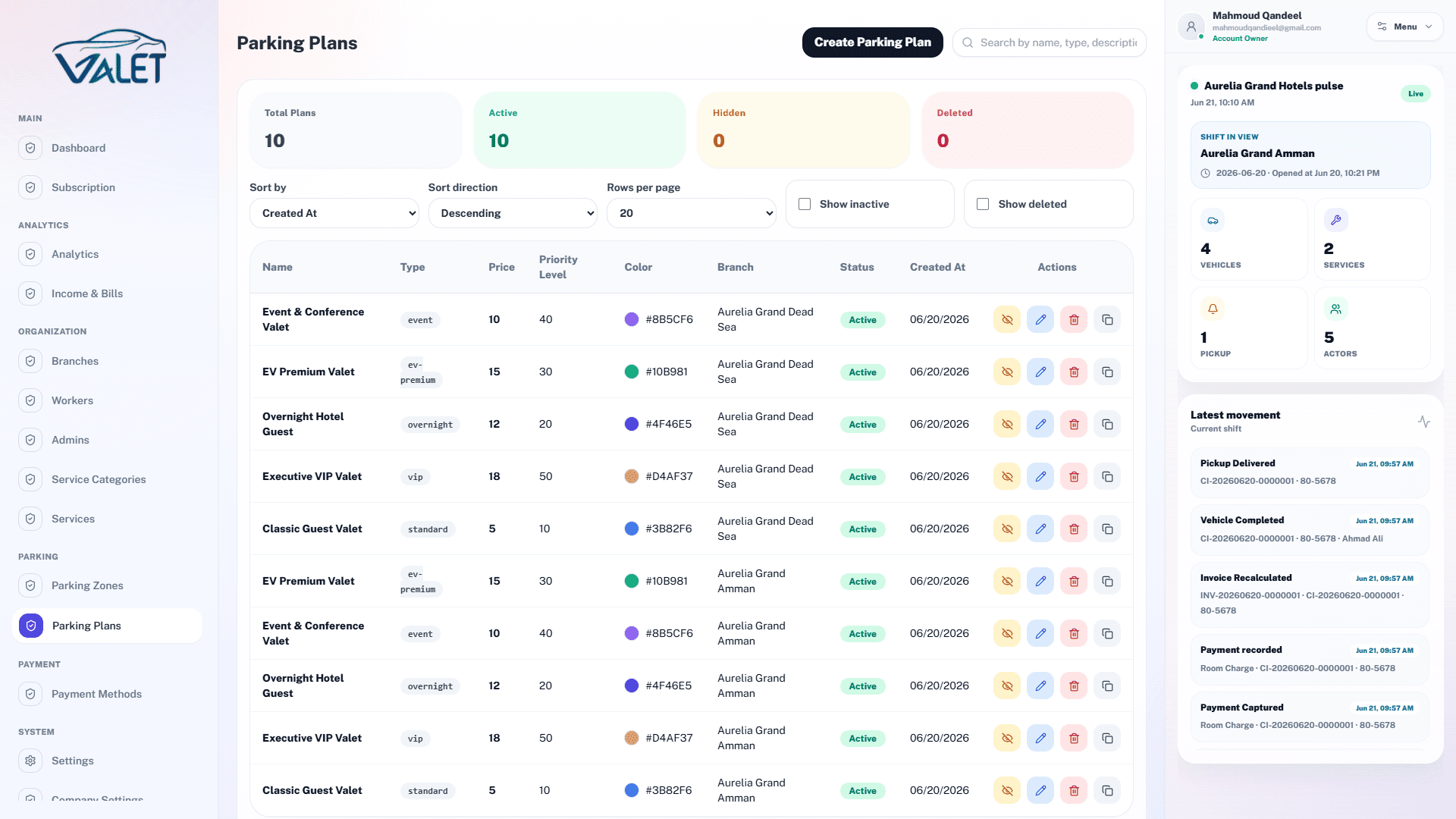
Parking plans
Configurable parking plans for recurring operational models and commercial packages.
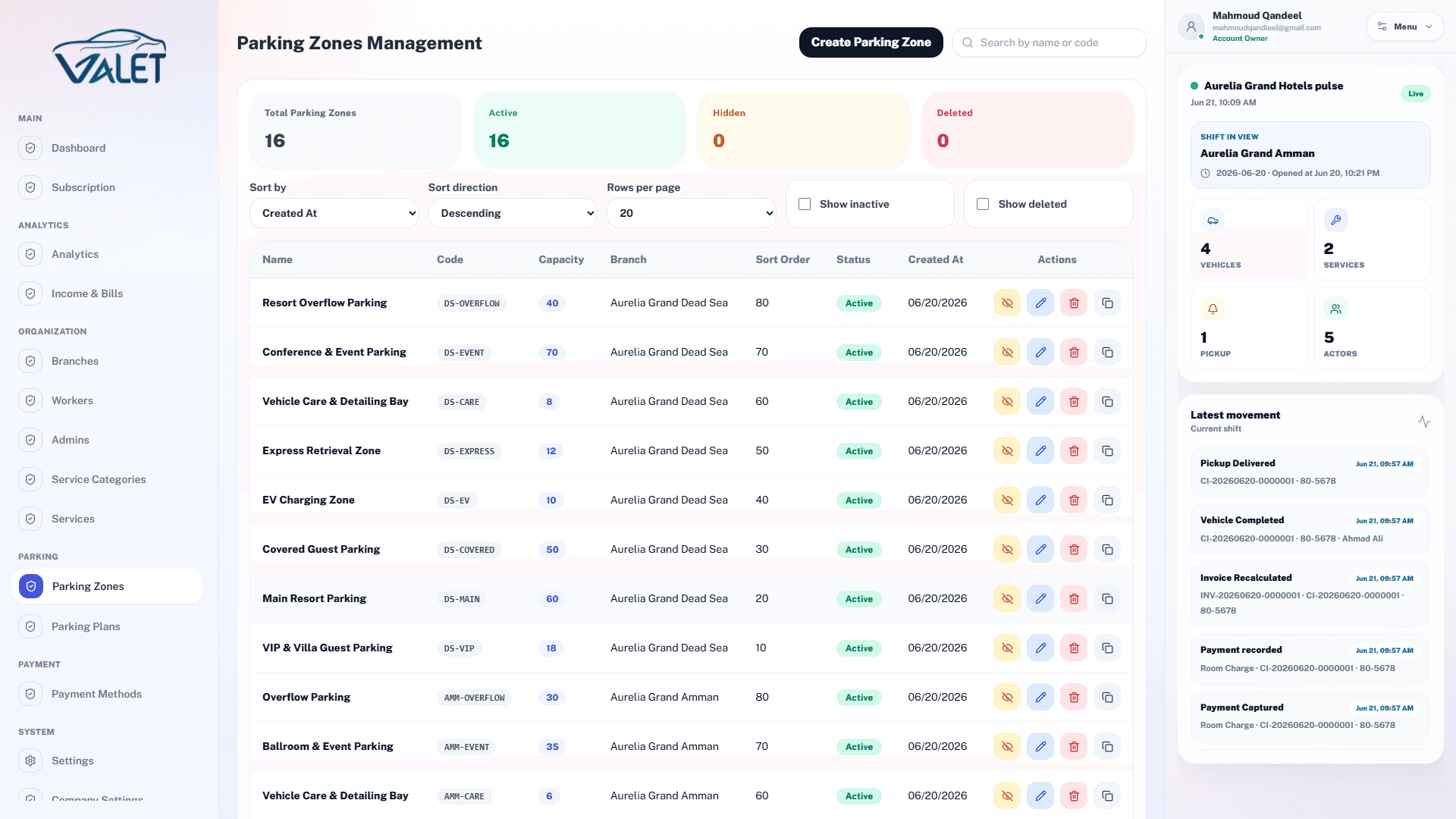
Parking zones and locations
Clear zone structure so teams know where vehicles are parked and how capacity is being used.
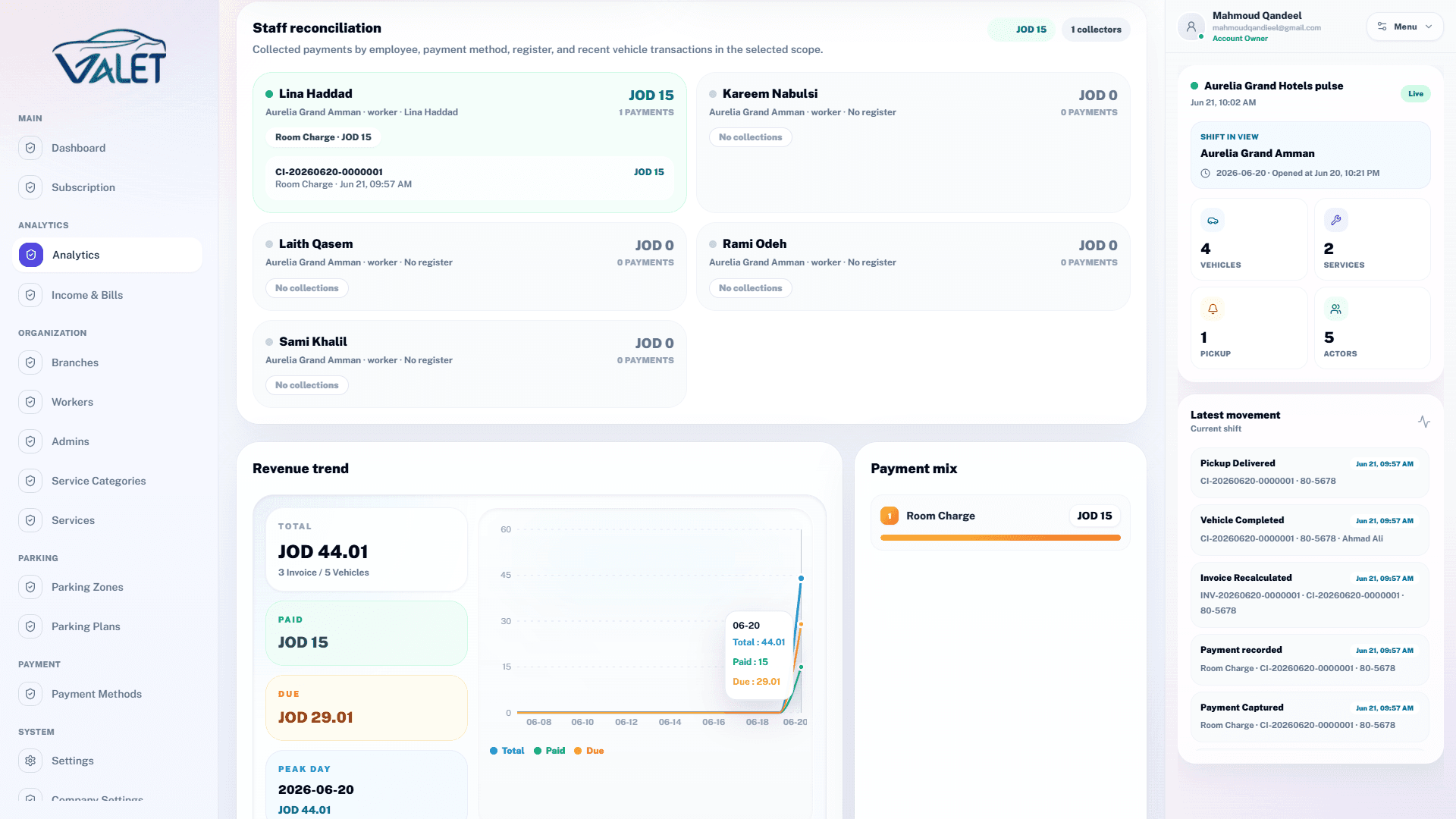
Detailed analytics breakdown
A deeper layer for comparing periods, finding bottlenecks, and proving operational improvements.
Metrics that prove the operation is improving
Check-in time
Measures how quickly an arrival becomes a trackable ticket.
Retrieval time
Reveals bottlenecks when many guests leave at the same time.
Open tickets
Gives supervisors a live picture of current operational pressure.
Service revenue
Shows the commercial impact of add-ons such as wash or premium handling.
Branch performance
Helps management compare sites using the same operating language.
Mistakes that block growth
- Buying a system before standardizing the operating workflow.
- Relying on tickets without clear parking location.
- Ignoring mobile training for field attendants.
- Treating reports as accounting only instead of operating intelligence.
- Letting branches work differently and then trying to compare results.
Practical next steps
- Define vehicle statuses from arrival to handover.
- Make parking location a required field, not an optional note.
- Tie each important movement to a staff member or role.
- Use customer links to reduce random phone calls.
- Review daily reports before the shift context disappears.
- Compare branches weekly with the same metrics.
- Train the team on the workflow before adding complexity.
- Connect plan expansion to real operating volume, not vague expectations.
FAQs
Can this be applied without new hardware?
Yes. The strongest first step is usually workflow discipline supported by software.